For WooCommerce stores selling configurable products, WooCommerce dynamic pricing by attributes replaces the variation-per-combination model with a leaner system: each attribute value carries a pricing rule, and the final product price is assembled from those rules at the moment a customer makes their selections.
This article explains how the system works — the data model behind it, how rules are evaluated at runtime, how price updates reach the customer, and where this architecture outperforms the conventional approach for complex configurable catalogs.
What Is WooCommerce Dynamic Pricing by Attributes?
Attribute-based dynamic pricing is a pricing model where the final price of a configurable product is calculated on demand from a set of pre-defined rules, rather than being retrieved from a pre-generated combination record in the database.
In standard WooCommerce, a variable product stores one record per attribute combination. A product with three attributes of four values each requires 4 × 4 × 4 = 64 variation records, each with its own price stored in the database. In an attribute pricing model, the same product stores 12 pricing rules — one per attribute value — and calculates the price at runtime by summing the modifiers for whatever combination the customer selects.
Attributes as Pricing Modifiers
Each attribute value maps to a price modifier. A modifier can take one of several forms:
- Fixed addition: Add a flat amount to the base price — for example, +$50 for a Large size
- Fixed subtraction: Reduce the base price by a flat amount
- Percentage modifier: Add or subtract a percentage of the current running price
- Price override: Set the total to a specific value regardless of other selections
The system evaluates each selected attribute in turn, applies its modifier to the running price, and delivers the result as the customer-facing price.
Why WooCommerce Variations Are Not Built for Complex Configuration
The variation model works well for products with a small number of simple options. It breaks down structurally when the number of configurable dimensions grows, and that breakdown affects three layers of the store simultaneously.
Combinatorial Explosion
Variation counts grow multiplicatively as attributes are added. A product with four attributes of five values each requires 5 × 5 × 5 × 5 = 625 variation records. Add a fifth attribute of five values: 3,125. Each new attribute multiplies the existing count rather than adding to it.
These records are stored in wp_posts as product_variation entries, each accompanied by eight to twelve rows in wp_postmeta covering price, SKU, stock, and attribute values. At hundreds of variations per product, the postmeta table becomes the primary performance bottleneck.
Maintenance Overhead
Prices in the variation system are stored per variation, per product. A WooCommerce price based on attributes — for example, a material surcharge — must be reflected in every variation that uses that material across every product. For a catalog with twenty products and three material options, a single material price change involves editing sixty individual variation records.
Attribute-based pricing collapses this to a single rule update that propagates across the entire catalog instantly.
Scalability Limits
WooCommerce issues a built-in warning at 50 variations per product. Beyond 150, the admin interface paginates the Variations tab. Beyond several hundred, the product page ships a large serialised JSON payload to the browser containing data for every variation — measurably increasing page weight and degrading Core Web Vitals scores on every product page load.
These are not edge cases. They are the normal operating range for any store offering genuine product customisation at catalog scale.
How WooCommerce Attribute Pricing Works
The attribute pricing model replaces the variation table with a rule store. Each pricing rule associates an attribute value with a price modifier. Rules are evaluated at request time rather than precomputed at product creation time.
Base Price
Every product starts with a base price — the minimum price before any attribute selections are applied. This is the number the pricing engine starts from when a customer opens the product page.
Rule Evaluation Sequence
When a customer makes attribute selections, the pricing engine looks up the rule for each selected value and applies it in sequence. Starting from the base price, each attribute's selected value contributes its modifier — a fixed addition, a percentage, or a subtraction — to the running total. Once all attributes have been evaluated, the accumulated result becomes the displayed price.
The number of operations equals the number of attributes, not the number of possible combinations. A product with six attributes performs six rule lookups regardless of whether it theoretically supports sixty or six thousand configurations. Performance is constant.
Real-Time Price Updates
Price recalculation is triggered on the product page each time a customer changes a selection. A lightweight AJAX request sends the current attribute state to the server. The pricing engine evaluates the applicable rules and returns the updated price to the page without a reload.
The result is a WooCommerce price calculator experience: the displayed price responds to selections in real time, giving customers a clear, trustworthy view of exactly what a given configuration costs before they add it to the cart.
Example: Custom Office Desk Configurator
A custom desk is offered at a base price of $299. Three configurable attributes determine the final price: frame material, desktop size, and surface finish. Each option carries a fixed price modifier.
| Attribute | Option | Price Modifier |
|---|---|---|
| Frame Material | Bamboo | +$0 (base) |
| Frame Material | Solid Walnut | +$180 |
| Frame Material | Powder-Coated Steel | +$95 |
| Desktop Size | Medium (120 × 60 cm) | +$0 (base) |
| Desktop Size | Large (160 × 80 cm) | +$60 |
| Desktop Size | XL (200 × 90 cm) | +$90 |
| Surface Finish | Natural (untreated) | +$0 (base) |
| Surface Finish | Oiled | +$35 |
| Surface Finish | Lacquered | +$55 |
Calculating the Final Price
A customer selecting Solid Walnut, XL, Lacquered pays: $299 + $180 + $90 + $55 = $624.
A customer selecting Bamboo, Medium, Natural pays: $299 + $0 + $0 + $0 = $299.
The same 9 pricing rules cover all 27 possible configurations of this product. The variation model would require 27 separate records — each needing to be individually priced at setup and individually updated if any modifier changes.
System Behavior: Cart, Checkout, and Orders
The pricing calculation does not stop at the product page. The configured price and selections must pass accurately through WooCommerce's cart and checkout flow.
Adding to Cart
When the customer confirms their configuration and adds the product to the cart, the selected attribute values and the calculated price are stored as cart item metadata. WooCommerce uses this stored price when calculating cart totals, applying coupons, computing tax, and calculating shipping — all via the standard cart infrastructure without modification.
Checkout
At checkout, the configured price is bound to the order line item. No variation ID is referenced — the order records the attribute selections and the agreed price. Tax recalculation, discount rules, and payment processing all operate on the stored line item price as they would for any WooCommerce product.

Order Management
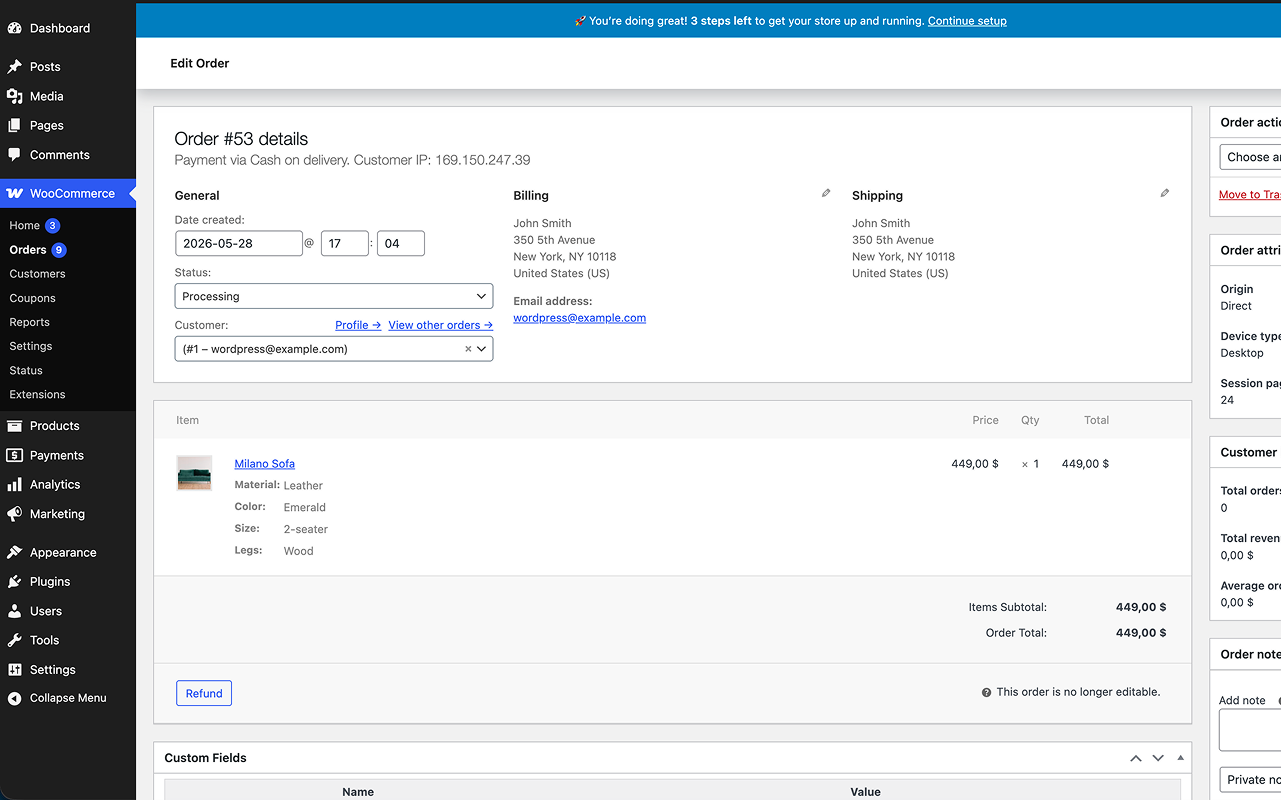
Admin order views display the attribute selections alongside the product name and price, giving store managers full visibility into what was configured. Order confirmation emails surface the same information to customers. Fulfillment, refunds, and reporting all work against the stored order data in the standard WooCommerce way.
Data Architecture: Rule-Based Storage vs. Combinatorial Storage
The database difference between the two models is most visible at scale.
Consider a product with 100 possible attribute combinations. The variation model requires 100 product_variation posts and approximately 800–1,000 rows in wp_postmeta for that single product. Across fifty products at the same scale: 5,000 variation posts and up to 50,000 metadata rows — all queried together whenever WooCommerce loads product data.
The attribute pricing model for the same product stores a rule set of roughly 12–20 rules. Across fifty products sharing the same attribute structure: still the same 12–20 rules, because rule sets are shared rather than duplicated per product. The database footprint is flat regardless of how many products use the same pricing structure.
Centralised Rule Management
Rule sets exist independently of individual products. Assigning the same rule set to multiple products links them to a single shared pricing definition. Update one rule — for example, increase the modifier for a material tier — and every product referencing that rule set reflects the change without any additional editing.

Runtime Evaluation Performance
Pricing is evaluated at request time rather than precomputed. The evaluation performs a small number of indexed database lookups — one per attribute in the selected configuration. On a standard WooCommerce installation this completes in milliseconds, adding negligible overhead to the AJAX pricing request.
The product page itself does not ship variation data to the browser. There is no inline JSON payload containing records for every possible combination. The page HTML stays lean, and pricing data is fetched only when a customer explicitly requests a price — only for the configuration they are actually building.
Use Cases for WooCommerce Product Options Pricing
Furniture and Interior Products
Configurable furniture — sofas, tables, shelving, lighting — priced by material, size, colour, and finish is the natural home of attribute-based pricing. The number of options is high, but the logic is simple: each option adds a known modifier. No physical stock distinction exists between most combinations, making variation-level records redundant for the majority of these products.
Custom Print and Production
Commercial print products priced by paper grade, print method, format size, and quantity tier map cleanly to attribute rules. A print shop with fifteen paper grades, six print methods, and twelve format sizes would require 1,080 variation records per product under the traditional model — but only 33 pricing rules under the attribute model.
Made-to-Order Manufacturing
Industrial and manufacturing products configured by material grade, surface treatment, or dimensional specification follow the same pattern. The configurable space is large; the pricing logic is systematic. One rule per specification value, evaluated at runtime from whatever combination the buyer selects.
Service Packages and Configurable Deliverables
Service products where scope, timeline, or feature inclusions drive price work identically to physical configurable products in the rule-based model. A custom project priced by deliverable count, revision rounds, and turnaround tier is structurally a base price modified by attribute selections — the same pricing engine handles it without any domain-specific adaptations.
Advantages of Attribute-Based Pricing Over Variations
Linear Scalability
Record count grows with the number of unique attribute values, not their combinations. Adding a new attribute option adds one rule. Adding a new product that uses an existing rule set adds zero records to the pricing layer. The system's data footprint is proportional to the genuine complexity of the pricing logic — nothing more.
Catalog-Wide Price Updates
Changing a pricing rule propagates to every product that references it instantly. No product-by-product editing, no bulk scripts, no risk of inconsistency. For stores where pricing is partially driven by supplier costs or material markets, this eliminates an entire category of ongoing maintenance work.
Faster Product Setup
Adding a new configurable product to a store with an existing rule infrastructure requires setting a base price and assigning the rule set. No variation generation, no per-variation pricing. For agencies managing large or frequently updated catalogs, this compounds into significant time savings across a project.
Stable Frontend Performance
Product pages carry no variation payload. Page weight is independent of the number of possible configurations — a product supporting 10,000 theoretical combinations loads identically to one with 10, because the browser receives no combination data until a customer explicitly requests a price for what they are building.
Simplified Pricing Governance
WooCommerce pricing rules live in a centralised rule store, not distributed across thousands of variation records spread across dozens of products. Store managers and developers can review and update the full pricing structure for a product line in one place, rather than navigating paginated product editors across the entire catalog.
Conclusion
WooCommerce dynamic pricing by attributes is a structural alternative to the variation model. Instead of precomputing and storing every possible configuration as a database record, it stores one pricing rule per attribute value and assembles the final price at runtime from the customer's selections.
The result is a system where database records grow linearly with genuine pricing complexity, not exponentially with the Cartesian product of attribute counts. Rule sets are defined once and shared across unlimited products. Price updates apply instantly and globally. Frontend performance is independent of configuration depth.
For WooCommerce stores selling furniture, print products, made-to-order goods, or any catalog where customers genuinely configure what they buy, WooCommerce product configurator pricing built on attribute rules is the architecture that scales — and understanding how it works is the first step toward building it effectively.